Tesis sobre infraestructura,
regulación y verdad digital.
Análisis estratégico sobre gobernanza de IA, evidencia criptográfica y marcos regulatorios europeos — para equipos jurídicos, de compliance y dirección ejecutiva.
publicados
temáticas
DORA · NIS2
Inventario de sistemas de IA: guía práctica de compliance | V-PROOF
La mayoría de organizaciones que inician un programa de AI governance descubren el mismo problema: no saben exactamente qué sistemas de IA están usando. No de forma centralizada ni actualizada. Sin inventario no hay governance — y sin governance no hay compliance con el EU AI Act ni con ISO 42001.
Por qué tu herramienta de GRC no es suficiente para gobernar la IA y qué sí lo es
Los GRC no tienen capacidad de enforcement en tiempo real, no evalúan riesgo dinámico y no generan evidencia verificable de forma independiente. Descubre qué diferencia una plataforma real de AI Governance.
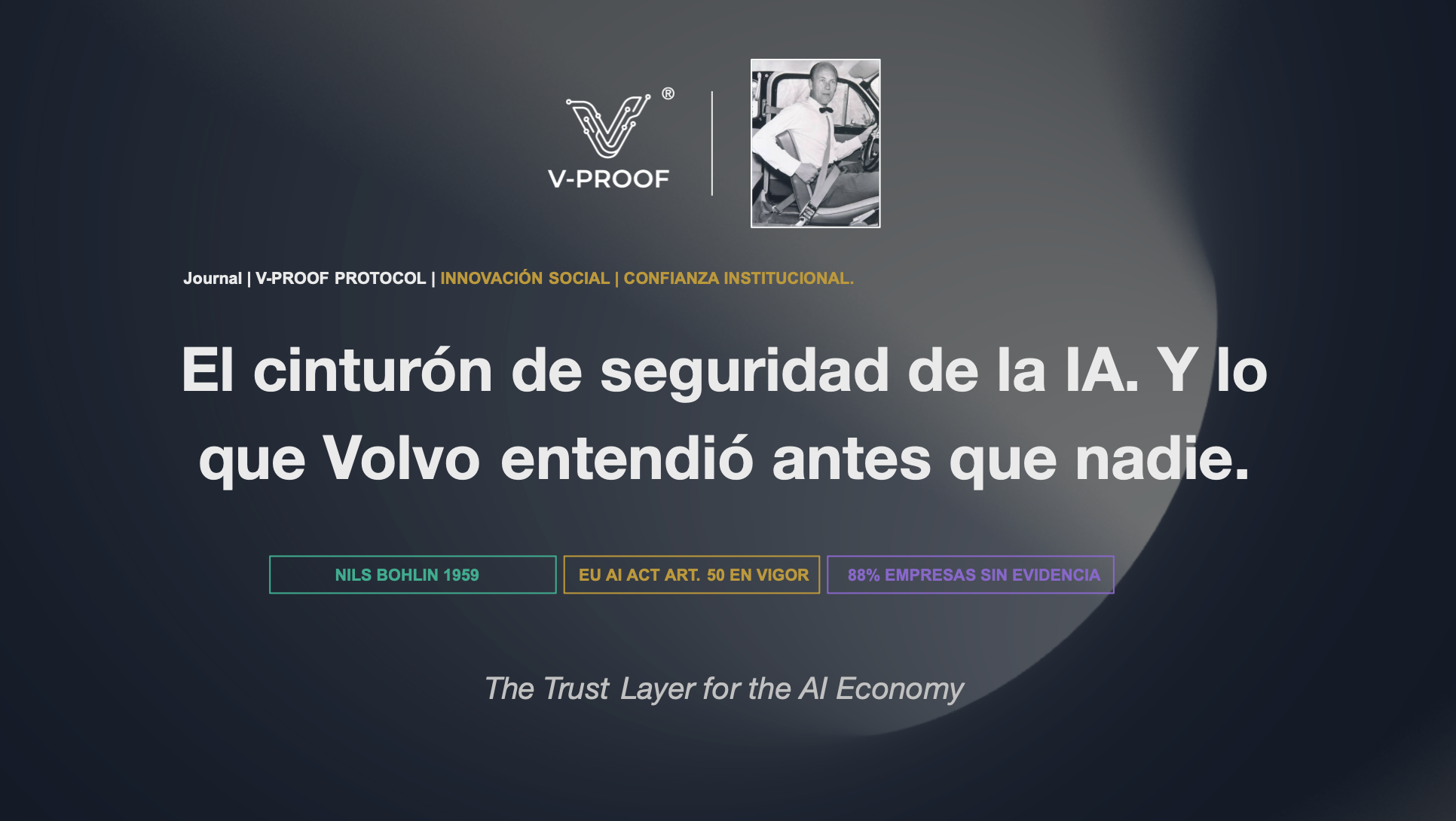
El cinturón de seguridad de la IA. Y lo que Volvo entendió antes que nadie.
En 1959, Nils Bohlin inventó algo que nadie había pedido. Volvo lo patentó y luego regaló la patente. No para ganar dinero — para que la confianza en el automóvil fuera un estándar universal. Hoy estamos en ese mismo momento con la IA. El problema no es tecnológico. Es de evidencia.
Por qué la infraestructura probatoria no es gobernanza de datos y la diferencia importa.
El mercado de la gobernanza de la IA está creciendo deprisa. Y con él, una confusión que tiene consecuencias reales. Cada semana aparecen plataformas que prometen "registros inmutables" y "compliance por construcción". Todas usan el mismo vocabulario. Pero no todas resuelven el mismo problema.
Governance as Code: el fin de los controles en documentos y el inicio de los guardrails ejecutables
Qué es Governance as Code, por qué los GRC no son suficientes para gobernar la IA y cómo V-PROOF implementa guardrails ejecutables en tiempo real sobre activos generados por inteligencia artificial.
2 de agosto de 2026: lo que cambia hoy para las organizaciones que usan IA de alto riesgo
El EU AI Act entra en vigor hoy para sistemas de IA de alto riesgo. No es una fecha de transición — es el inicio del periodo en el que las autoridades pueden investigar, requerir documentación y aplicar sanciones de hasta el 3% de la facturación global. Muchas organizaciones que llevan meses preparando su compliance descubrirán el mismo problema: sus registros actuales no generan la evidencia verificable que el Reglamento exige.
Gobernanza de IA: 30 preguntas clave, 8 marcos regulatorios, 1 capa de evidencia
Todos los marcos de gobernanza de IA — POPIA, ISO 42001, ISO 27001, ISO 27701, EU AI Act, NIST AI RMF, PCI DSS e HIPAA — definen el qué. Ninguno certifica el cómo ni el cuándo. Esta matriz cruza las 30 preguntas críticas de gobernanza contra los 8 estándares globales y añade la capa que faltaba: evidencia criptográfica verificable por cualquier auditor europeo. Compliance declarativo vs. compliance verificable.
La primera obligación del reglamento de IA.Y no es técnica. #ARTÍCULO 50 AI ACT
La primera obligación del EU AI Act no es técnica. El Artículo 50 entró en vigor el 2 de agosto de 2025 y exige a cualquier operador que usa IA informar de forma clara cuándo hay una máquina al otro lado. Análisis completo con marco legal, calendario y sanciones: hasta 15M€ o el 3% de facturación global.
El tren de los modelos fundacionales ya ha salido. Europa tiene otro.
La carrera de la inteligencia artificial no se gana únicamente con cómputo. Europa no compite en esa liga — y no tendría que intentarlo. Compite en otra: la confianza verificable, la soberanía jurídica y la capacidad de convertir la regulación en infraestructura estratégica. Opinión de Gil Blancafort, fundador de V-PROOF Protocol, publicada en Expansión (julio 2026).
El primer Magic Quadrant de AI Governance: qué mide Gartner y dónde queda la evidencia verificable
En junio de 2026, Gartner publicó su primer Magic Quadrant for AI Governance Platforms. 13 vendors evaluados. Ninguno opera en el espacio donde actúa V-PROOF.
La Vanguardia destaca la "caja negra" de la IA: V-Proof Protocol en el Especial Empresas
El incumplimiento puede costar hasta 35M€ o el 7% de la facturación global. La Vanguardia dedica un reportaje a V-Proof Protocol: la infraestructura nacida en Barcelona que convierte la supervisión humana de la IA en evidencia verificable, ante la EU AI Act que entra en vigor el 2 de agosto de 2026.
EU CRA: Code Traceability and Vulnerability Management as Law
EU Cyber Resilience Act: requisitos de ciberseguridad para productos software y cómo cumplirlos
How V-PROOF Helps V-PROOF DORA Compliance and the Financial Sector
El Reglamento DORA es de plena aplicación desde enero 2025. Arts. 9, 10, 11 y 17 exigen registros TIC verificables. V-PROOF los genera con timestamp blockchain desde el origen.
GDPR and ENS in the Age of AI: How to Demonstrate Accountability with V-PROOF Cryptographic Evidence
El RGPD exige accountability real, no declarativa. En entornos con IA, los Arts. 5, 25 y 30 requieren trazabilidad verificable de tratamientos. V-PROOF genera la evidencia que la AEPD puede auditar.
NIS2 in Spain: What Directive 2022/2555 Requires and How to Demonstrate Compliance with V-PROOF
La Directiva NIS2 amplía el alcance a miles de entidades en España. Art. 21 exige evidencia técnica de medidas de ciberseguridad. V-PROOF genera los registros verificables que el CCN-CERT y el DSN exigen.

V-PROOF: Spain's first AI governance platform that turns compliance into cryptographic proof
Siete módulos integrados que cubren EU AI Act, EU CRA, GDPR y DORA/NIS2 desde una sola integración. Arquitectura SHA-256 + IPFS + Base L2. El único proveedor de origen europeo libre del CLOUD Act.
Why Your Organization Needs V-PROOF Than a Platform Based Outside the European Union
Of the 13 vendors in Gartner’s first AI Governance Magic Quadrant, none are based in the EU. We examine why using a platform outside the European Union to comply with the EU AI Act a structural legal contradiction—and what sets V-PROOF .
Implementation Timeline for the EU AI Act: Current Requirements and Changes Under the Digital Omnibus
A Practical Analysis of Regulation (EU) 2024/1689: Which obligations take effect in August 2025, what changes with the Digital Omnibus, and what your organization should do before the next thresholds take effect.
IPFS and Quantum Computing: Why the evidence you seal today with V-PROOF be valid in 2035
How V-PROOF decentralized architecture V-PROOF IPFS, SHA-256, and the NIST PQC roadmap to ensure that your digital evidence stands the test of time.
V-PROOF : Software Lifecycle Traceability in the Era of the EU Cyber Resilience Act
V-PROOF every commit, review, and production deployment—creating an auditable, immutable software supply chain that complies with the EU Cyber Resilience Act.