—quality, environment, and safety—that can be demonstrated.
An ISO management system relies on documents: policies, procedures, records, and minutes. V-PROOF adds verification: each revision is signed with a cryptographic fingerprint, published with a V-Seal , and includes a QR code that tells the person holding the copy whether it is still valid. Whether it’s ISO 9001, 14001, 45001, 27001, or whatever standard your organization requires, it’s all on the same platform that governs your AI.
A management system, from policy to certification package.
One minute and 15 seconds on the V-PROOF Portal, using V-PROOF's own quality management system: from the signed document to the copy that indicates whether it is still valid.
The problem: copies that no one keeps track of and signatures that don't prove what was signed.
Signatures by step, following the archive's trail, with separation of duties.
A QR code on each copy and the document package sealed for certification.
The certificate V-Seal, which anyone can verify without needing an account.
Document control with verifiable evidence.
V-PROOF shows which version is current and who approved it.
There's no need to change the way you work: existing documentation is uploaded, linked to the clauses, and enters the approval process.
Signatures that do not prove what was signed
An approval in a workflow simply indicates that someone clicked a button; it doesn't specify which exact file they were looking at.
Signatures associated with the file
Create, review, and approve: Each signature is from a person whose name appears on the file's fingerprint, calculated in their own browser. If the file changes, a new review is required.
Copies that no one controls
A form printed at the repair shop or sent by mail, with no way of knowing if it is still valid.
A QR code that knows when it's out of date
Anyone who scans the copy can easily see whether that revision is still in effect, whether it has been replaced by another one (which one and as of when), or whether it has been withdrawn.
An audit that starts by looking for documents
The agency requests current documentation, and someone compiles it by hand, with no way to verify that it hasn't changed between one phase and the next.
A sealed package of documents
A single stamp containing all current documents, their revisions and versions, coverage by clause, and open findings. The agency verifies it without accessing the platform.
The Journey of a Document
Your documentation
Policy, procedure, or record, in PDF, Word, Markdown, or other formats.
Upload
The platform calculates the file's footprint. One file, one revision.
View and verify
The browser recalculates the fingerprint: what you see is what you sign.
Draft, review, approve
Signatures by step and with separation of duties: the person who prepares the document does not approve it.
Publish and seal
The revised version takes effect as of V-Seal; the previous version is superseded.
Confirmation of Receipt
Each person confirms that they have read that specific review.
Public Verification
The QR code on any copy indicates whether it is valid, has been replaced, or has been withdrawn.
What verifiable evidence
bringsto your management system.
Coverage, preparation, and the documentation package are calculated based on the record, without AI. When AI is involved, it only makes suggestions; a person makes the final decision.
Signatures associated with the file
The "Sign" button is only enabled if the fingerprint calculated by the browser matches the one from the review. No one signs on behalf of another person.
A QR code that knows when it's out of date
Current, replaced, or withdrawn; checked at the time of scanning, not at the time of stamping.
Sealed Document Package
Compare the Phase 1 package with the Phase 2 package and identify what has changed between the two.
Read Receipts with Proof
Each acknowledgment records which version the person has read.
Coverage per clause, without IA
What applies, what documented information is expected, what is currently in effect, and what findings are pending.
AI makes suggestions; a person decides
It indicates which provisions a document covers; nothing is retained without consent. Confidential documents never leave the premises.
Certified date for each record
Management review records, audit reports, and change logs, stamped with a verifiable date.
A single platform
V-PROOF itself complies with the IA standard (ISO/IEC 42001) and supports whichever management system you choose: ISO 9001, 14001, 45001, 27001, or another.
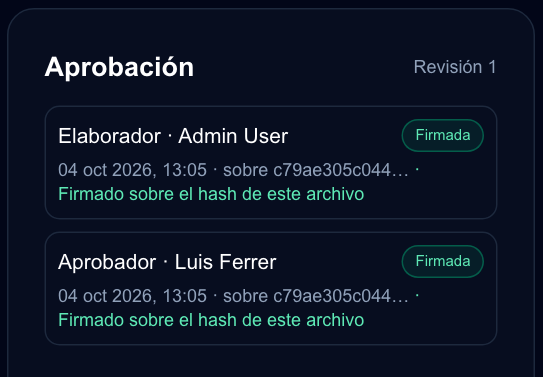
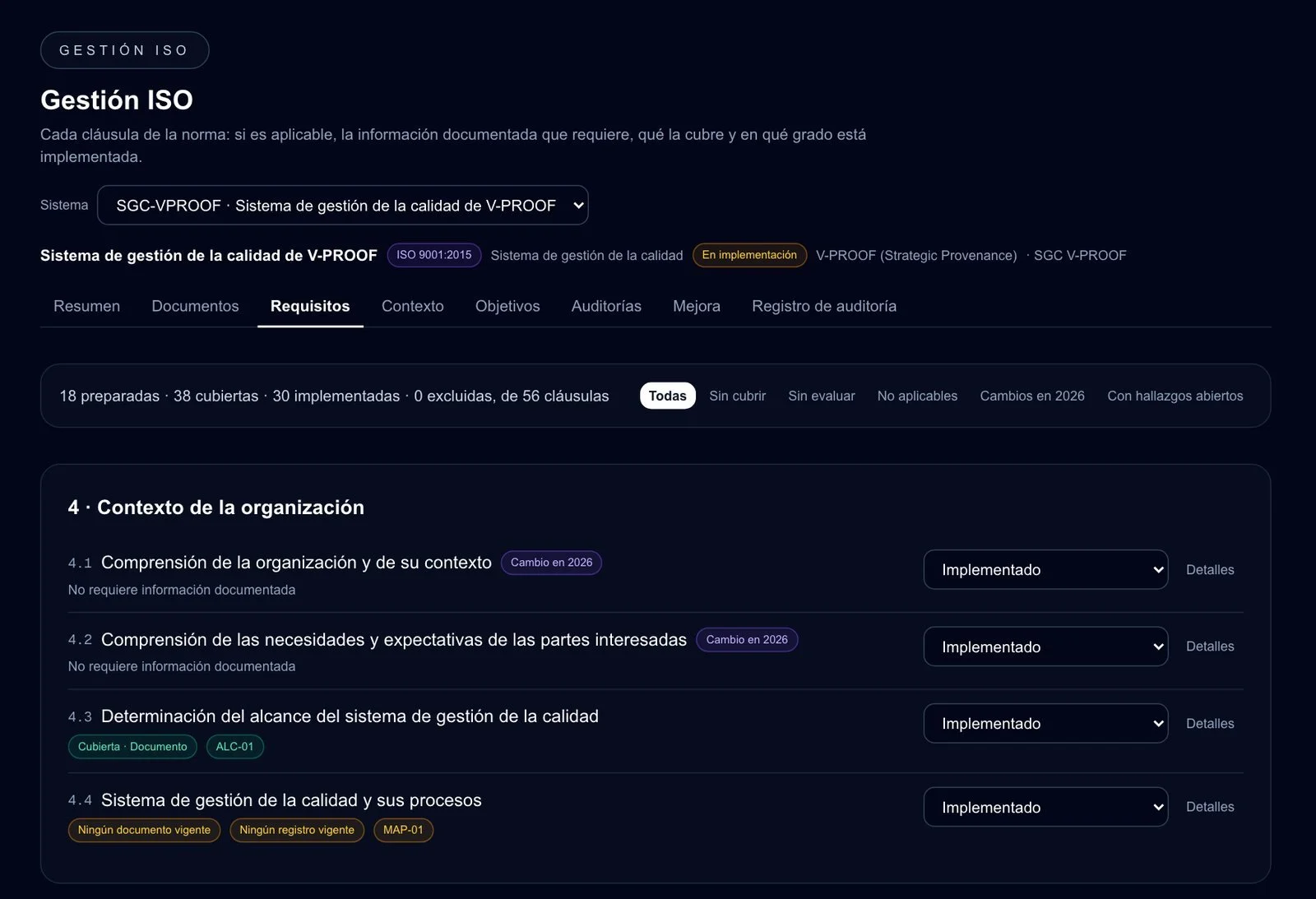
Actual screenshots from the V-PROOF Portal, captured from V-PROOF's own management system. Sample data.
The standards you need.
A single structure.
V-PROOF supports your ISO management system, regardless of the standard. All standards share the same harmonized structure (context, leadership, planning, support, operation, evaluation, and improvement), and each adds its own specific elements. Here are four examples:
ISO 9001Quality Management System
Context and stakeholders, risks and opportunities with calculated scores, process map, objectives with indicators, internal audit, and management review.
Nonconformities are not closed until the effectiveness of the corrective action has been verified. The catalog highlights the clauses that have changed in ISO 9001:2026.
ISO 14001Environmental Management System
Environmental aspects, including their operational status, life cycle stage, and significance; legal requirements, including the results of the most recent compliance assessment.
Emergencies and drills are included in the same program as audits, with their reports serving as controlled records.
ISO 45001Occupational Health and Safety Management System
Hazards related to the hierarchy of controls, including psychosocial hazards; worker consultation and participation as a controlled procedure and record.
Incidents and near-misses as findings, with a worker's report as the source.
ISO/IEC 27001Information Security Management System
Risk assessment and treatment, statement of applicability, and controls in Annex A, each with its documented information signed, stamped, and current.
It follows the same system: the same signatures, the same stamps, and the same QR code as the other regulations.
The copy I have in my hand indicates whether it is still in effect.
The classic problem with document control is uncontrolled copying. With V-PROOF, publishing a revision means sealing it, and its QR code links to the public verification page, which checks the status of that revision at that moment. The QR code checks the status of the associated revision. To verify that a specific file corresponds to that revision, it is uploaded and its digital fingerprint is compared: on a printed copy, the QR code indicates whether the revision is still valid, not whether the paper itself has been altered.
A package for the certification body.
Before the audit, a single stamp consolidates all current information: each document with its revision and timestamp, coverage by clause, and open findings. The agency verifies this without counting and checks each document against the timestamp listed in the package.
What does someone see when they scan the QR code on a copy?


Actual screenshots from the V-PROOF Portal, captured from V-PROOF's own management system. Sample data.
What it does and what it doesn't do.
We'd prefer that you know this before the first demonstration.
- It does not certify. Certification is issued by an accredited body; V-PROOF organizes, monitors, and seals the evidence that the accredited body will review. The documentation it provides is the organization’s self-assessment.
- Approval signatures are internal evidence linked to a file's digital signature and to an authenticated individual. They are not qualified electronic signatures (eIDAS).
- It does not reproduce the text of the regulations. The titles of the provisions are cited; the summaries and evidence guidelines are the author’s own wording. The regulation must be purchased.
- It does not yet send notifications by mail: pending signatures, acknowledgments, and reviews appear in the System Summary.
- It still doesn't sync from GitHub: documentation stored in a repository is uploaded as a file.
- ISO 45001 does not replace the occupational safety and health service or the risk assessment required by law: it simply documents, signs, and stamps the work performed by authorized personnel.
Which versionof
is currently in effect,and who approved it?
Demonstration of their own management system, including its documentation.