Tesis sobre infraestructura,
regulación y verdad digital.
Análisis estratégico sobre gobernanza de IA, evidencia criptográfica y marcos regulatorios europeos — para equipos jurídicos, de compliance y dirección ejecutiva.
publicados
temáticas
DORA · NIS2
Inventario de sistemas de IA: guía práctica de compliance | V-PROOF
La mayoría de organizaciones que inician un programa de AI governance descubren el mismo problema: no saben exactamente qué sistemas de IA están usando. No de forma centralizada ni actualizada. Sin inventario no hay governance — y sin governance no hay compliance con el EU AI Act ni con ISO 42001.
Por qué tu herramienta de GRC no es suficiente para gobernar la IA y qué sí lo es
Los GRC no tienen capacidad de enforcement en tiempo real, no evalúan riesgo dinámico y no generan evidencia verificable de forma independiente. Descubre qué diferencia una plataforma real de AI Governance.
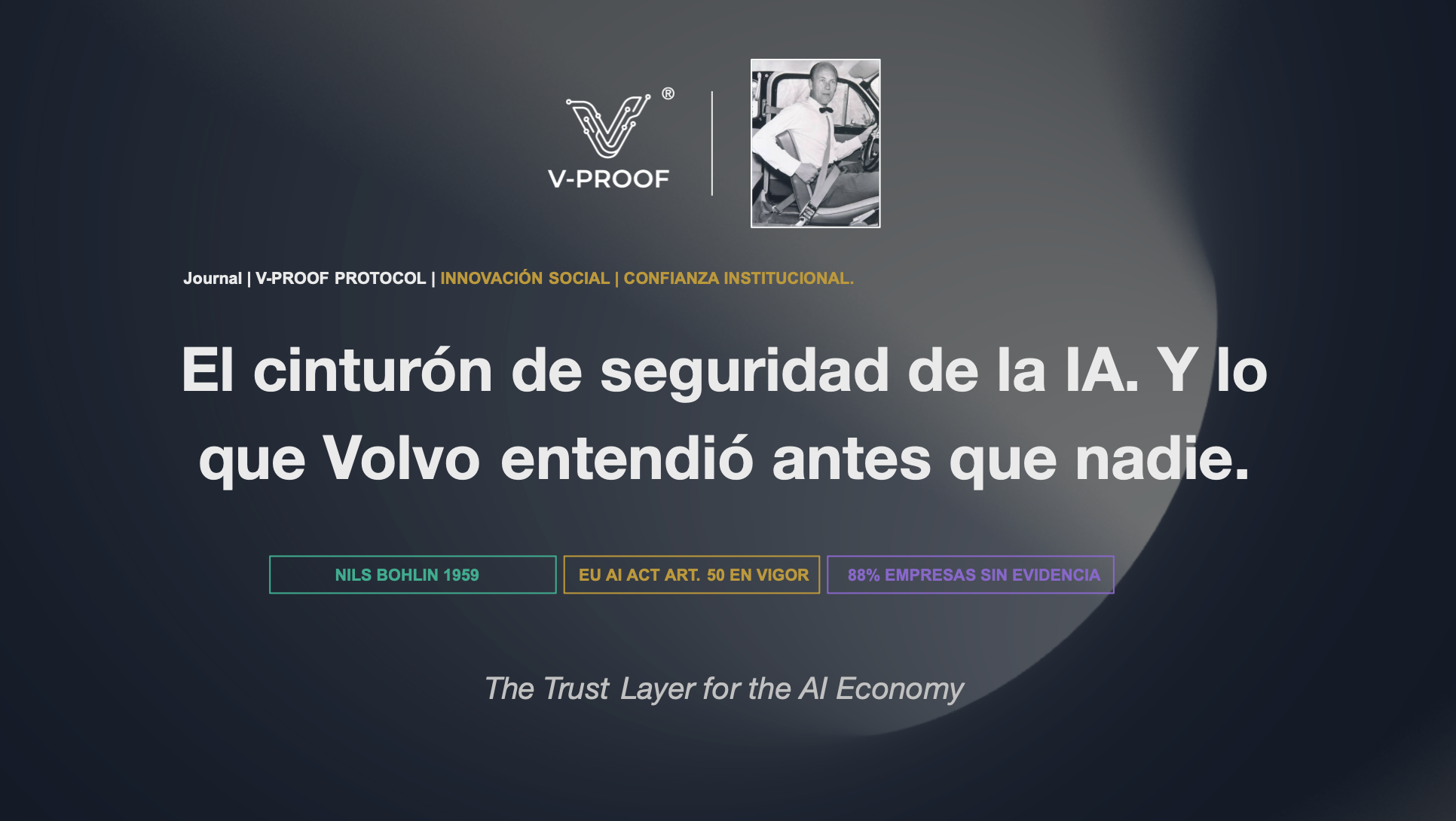
El cinturón de seguridad de la IA. Y lo que Volvo entendió antes que nadie.
En 1959, Nils Bohlin inventó algo que nadie había pedido. Volvo lo patentó y luego regaló la patente. No para ganar dinero — para que la confianza en el automóvil fuera un estándar universal. Hoy estamos en ese mismo momento con la IA. El problema no es tecnológico. Es de evidencia.
Por qué la infraestructura probatoria no es gobernanza de datos y la diferencia importa.
El mercado de la gobernanza de la IA está creciendo deprisa. Y con él, una confusión que tiene consecuencias reales. Cada semana aparecen plataformas que prometen "registros inmutables" y "compliance por construcción". Todas usan el mismo vocabulario. Pero no todas resuelven el mismo problema.
Governance as Code: el fin de los controles en documentos y el inicio de los guardrails ejecutables
Qué es Governance as Code, por qué los GRC no son suficientes para gobernar la IA y cómo V-PROOF implementa guardrails ejecutables en tiempo real sobre activos generados por inteligencia artificial.
2 de agosto de 2026: lo que cambia hoy para las organizaciones que usan IA de alto riesgo
El EU AI Act entra en vigor hoy para sistemas de IA de alto riesgo. No es una fecha de transición — es el inicio del periodo en el que las autoridades pueden investigar, requerir documentación y aplicar sanciones de hasta el 3% de la facturación global. Muchas organizaciones que llevan meses preparando su compliance descubrirán el mismo problema: sus registros actuales no generan la evidencia verificable que el Reglamento exige.
El primer Magic Quadrant de AI Governance: qué mide Gartner y dónde queda la evidencia verificable
En junio de 2026, Gartner publicó su primer Magic Quadrant for AI Governance Platforms. 13 vendors evaluados. Ninguno opera en el espacio donde actúa V-PROOF.
IPFS and Quantum Computing: Why the evidence you seal today with V-PROOF be valid in 2035
How V-PROOF decentralized architecture V-PROOF IPFS, SHA-256, and the NIST PQC roadmap to ensure that your digital evidence stands the test of time.
V-PROOF : Software Lifecycle Traceability in the Era of the EU Cyber Resilience Act
V-PROOF every commit, review, and production deployment—creating an auditable, immutable software supply chain that complies with the EU Cyber Resilience Act.
FFUUSS · OTS GROUP: AI Compliance Under Five Simultaneous ISO Certifications — Without a Single Nonconformity
FFUUSS · OTS GROUP: AI compliance with five ISO certifications + registered IP for all newly created digital assets.
"V-PROOF : The Trusted Infrastructure EU AI Act by the EU AI Act "
In less than two years, artificial intelligence has radically transformed corporate decision-making. But this revolution has brought with it an unprecedented challenge: regulatory risk. Faced with strict regulations such as the EU AI Act, the question echoing through boardrooms is clear: in the age of AI, how do you prove what is real, what is legal, and who created it?
Trust in the digital world can no longer rely on third parties or paper documents. Businesses need to prove their regulatory compliance instantly and with mathematical certainty. That is why we are announcing today the full rollout of V-Proof : the first Trust Layer Layer for the AI economy.
A new compliance standard designed to turn every corporate process and document into immutable evidence.
ROCADA: ISO 9001 traceability in an AI-assisted design process—version by version, without a single nonconformity.
AI-Driven Design Process + ISO 9001: How ROCADA Solved Document Traceability with V-PROOF. Zero nonconformities. Auditors verify via the QR code in seconds.
Enterprise Artificial Intelligence Now Has Its Own "Black Box"
Executive boards no longer have to choose between stifling innovation or exposing themselves to legal risks. We are pleased to announce the official launch of V-Proof , the first "black box" solution for enterprise AI that enables your teams to work with any large language model (LLM) while ensuring full compliance with the EU AI Act.
The press highlights the "black box" of AI: V-Proof on El 9 Nou
Gil Blancafort and David Reifs are bringing the V-Proof vision to the media. From the in-depth report on El 9 Nou highlighting our corporate "black box" and recent financial momentum, to the interview on Catalunya Ràdio declaring the end of paper-based compliance. Discover how Hardcoded Compliance shields companies from the impending EU AI Act.
"Corporate AI needs a black box, not an ethics manual": V-Proof on Catalunya Ràdio
Gil Blancafort, CEO of V-Proof , visits Catalunya Ràdio to explain how companies can protect themselves against the new European AI Act. Find out why "paper-based compliance" is a thing of the past and why corporate artificial intelligence needs an immutable "black box" to ensure legal certainty and avoid fiduciary risks.
From Experimentation to Evidence: What the 2026 Gartner Radar Tells Us About AI Governance
Just four months after the EU AI Act takes effect, the burden of proof will shift. If your company cannot cryptographically demonstrate human oversight of its AI, the law will presume non-compliance. Find out why probabilistic tools are no longer sufficient and how to prepare for the new era of mathematical certainty.
"Countdown to the 'Blind Trust Blackout'"
Prohibited practices and the obligations for general-purpose models under the EU AI Act are EU AI Act subject to penalties. Following the extension of the Digital Omnibus, the penalty framework for high-risk systems takes effect on December 2, 2027. Learn about the “presumption of non-compliance” for AI without human oversight and how to avoid fiduciary risk.
The End of the Corporate Blind Spot. AI Governance Now Has a Standard, and It’s Called V-PROOF®
Does your company comply EU AI Act the EU AI Act intellectual property? Simply signing a document is no longer enough if you can’t prove its origin. Find out why the era of “digital pens” is over and how the V-Proof infrastructure safeguards your corporate R&D.
Gartner's Ultimatum for the Enterprise: Why 'Governance by Design' Is the Only Way Forward for the EU AI Act.
Gartner issues its warning: blindly adopting AI poses an unacceptable fiduciary risk. Discover how V-PROOF becoming the standard infrastructure demanded by senior management to ensure mathematical certainty and evidentiary sovereignty in light of the EU AI Act.
The End of the Presumption of Innocence in Corporate AI: Why the Latest EU Report Changes Everything.
The impending regulatory pressure from the EU AI Act makes AI a fiduciary risk. V-PROOF its protocol into an infrastructure to establish the global standard for mathematical certainty and evidentiary sovereignty for senior management.